The
Personal Story Behind FiberWater
by Suzanne Jaffe Stillman
Dedicated
to my son, Jason Stillman
my best friend and teacher
 |
|
A Stumbling Block Became A Stepping Stone
I smile sometimes, when I look back, 22 years, and wonder what it was that inspired me to create Fiber-Water: a Mother's unconditional love, my determination to overcome the insurmountable, the passion? It really doesn't matter, because I'd made a promise to create Fiber-Water, and that was one promise I intended to keep — and here is why:
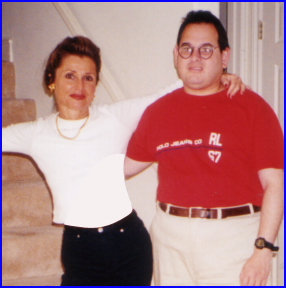
My son, Jason, was born with Glycogen Storage Disease (GSD) — a rare, metabolic genetic disorder affecting his ability to process glucose. I was determined to prove the doctors wrong when they said, "Babies with his condition rarely live past two or three." Determined to help him beat the odds, I became Jason's life support — administering glucose every four hours, around the clock, seven days a week for five years. Sleep, for me, was not an option.
Unwilling to accept his prognosis, I ventured for a solution which consisted of domestic and international calls, mailings around the globe, all night library searches and dealing with an unsympathetic health care system, until I found Boston Children's Hospital at Harvard Medical School, and what became a bi-coastal existence for the next 20 years.
I immersed myself in everything there was to learn about GSD, his condition and the prescribed treatment. The questions raised were almost as rare as the answers. After much consideration, it was determined that a gastrostomy tube would be placed surgically in Jason's stomach. This way he could be fed a glucose drip, with a pump, 12 hours a day, which would provide him the minimum amount of glucose necessary to live.
What became evident to me early on was that Jason literally had another mouth by which I could use the tube to augment his nutritional intake. What Jason didn't like, or wouldn't even try, went in the blender and administered through the tube, which looked like an outdated rubber hose.
This would have been a satisfactory solution for most people — but I was not "most people." There was much I needed to know and soon became, so I was later told, a thorn in the side of the medical profession.
Dealing with the tube itself became a nightmare. It was long and cumbersome. Additionally it irritated the surrounding tissue, causing incessant infection; and therefore needed to be changed often which was traumatic and painful. Further, wearing this tube was an embarrassment to Jason as well.During the three years in development,
my work was called “interesting”. Reflecting back, I think
that was the scientific community’s way of saying, “This
broad is nuts for tackling this thing”. Yet to everyone’s
amazement, including mine, my work ushered in the next generation of
intergastric feeding:
— a BUTTON ON THE STOMACH
For this work, I was granted two United States Patents for a percutanious transport tube with a one-way valve for inter-gastric feeding; along with numerous honors usually reserved for those with advanced degrees in bio-medical engineering.
Then reality hit hard. The device I developed with its one-way valve had a smaller opening than traditional tubes, which limited the form of nutritional sustenance to liquids with the consistency of water. Simply knowing which foods he needed wasn't enough. If you couldn’t get the nutrition past the tube and into the patient, the form and value of the contents didn’t matter. My challenge became how to pass nutrients through "the eye of the needle." Yes it was for Jason, but Jason also ate foods. There were children who needed to be fed around the clock. What had I created of value for those? It became my quest to find a way to introduce fiber, so nutritionally essential to "living healthy," into those patients.
Once again, I had to rethink my entire approach for Jason and NOW also the "others." There I was again, on the long and winding road. Luckily I found I could build on that base of knowledge so arduously learned from Jason, doctors, nurses, specialists, thick books, thin books, all before the internet was even a gleam in anyone's eye and "yahoo" was something you yelled before jumping off a high place. So I jumped right in and designed, before it was ever fashionable, what would be called by today's standards, "Nutriceutical Waters."
I recall as if it were yesterday, talking with the nurses while preparing a huge pot of Nutraceutical Water for Jason's tube, that I remarked, "someday I'll create a fiberwater and we won't ever have this problem again." They just smiled at my "crazy idea" but my mind was already on the road to creation.
A PROMISE KEPT: On June 19, 2001,
U.S. Patent 6,248,390 was issued for Fiber-water — water containing
soluble fiber, and is pending, internationally, in 40 countries.
After 9 years on the tube, Jason now takes cornstarch to maintain a
decent glucose level. 46,500 cups of cornstarch later, Jason still has
his genetic problem, but he's a fine young man of 32. As for me, I have
already invented: Fiber-Water the next generation; and always looking
for answers for Jason, and all the other children, for whom life has
dealt an unfair hand.
Thank You —