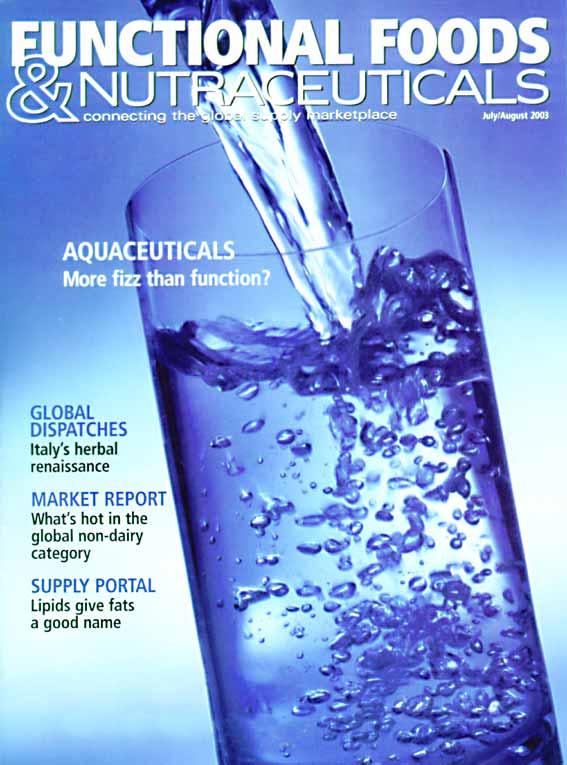
|
Aquaceuticals enter the mainstream market Functional waters are the latest 'must-have' lifestyle products. They're fast making inroads into the beverages category and reclaiming premium price points - but do they work or is their appeal based purely on perception? SHANE STARLING finds out As the millennium dawned they were virtually unheard of outside of Japan. Now it seems every beverage producer worth their ingredient palette is jumping on the functional waters bandwagon, creating a situation where most Western markets are literally awash with all manner of aquaceuticals. While they still occupy only a small percentage of the total bottled water market, booming functional water sales are being fuelled by consumer intrigue and massive marketing drives undertaken by the major beverage players like PepsiCo and CocaCola. They are also reclaiming the healthy price point premiums that have been whittled away in the regular bottled waters sector following the sales boom in that category. Food and drink consultancy Zenith International estimated the US market at $115 million in 2002. Responding to this lucrative market, powerful ingredient suppliers like ADM, Kemin and Roche are chiming in with new 'all-clear' ingredients to widen the variables scope for product formulators. ADM and Roche have both launched vitamin E ingredients suitable for water products. Kemin has launched a watersoluble version of its FloraGlo lutein ingredient which it claims "can be easily dispersed into water-based products with no clouding, no ringing, no clumping and no settling." To list recent product launches would fill a whole magazine, but some of the more noteworthy market additions in the past couple of years include PepsiCo's Aquafina Essentials (US) and Gatorade Propel (US and Europe), Coke's Dasani Nutriwater (US), Danone's Activ (Europe), GlaxoSmithKline's Lucozade HyperActive (UK), Reebok's Fitness Water (North America, in a joint venture between Reebok and Clearly Canadian Beverage Corporation), Nestle's Contrex, Vittel and Wellness (France, the UK and Germany respectively), Glacaeu Vitaminwater and Baxter Healthcare's Pulse Range (US). In addition to these mainstream products that, on the whole, target an under-35 demographic, are a host of niche products from smaller producers all trying to establish and promote unique selling points in a crowded marketplace. Examples include joint Juice (US) and Willow (UK). The rise of oxygenated waters is just one example of this frontierism regardless of whether these kinds of 'altered oxygen' waters are efficacious or not. One product, Penta Water, has notched serious sales in the US and was recently launched in the UK (clinical trials have been conducted and will soon be peer-reviewed, according to the company). Clinical trials should always be applauded but when it comes to functional water, with the market in its current state of maturity, it would seem functionality is not really an issue most producers, or indeed consumers, are overly concerned with. "The beverage
marketers have done an excellent job of lifestyle marketing but
most of these products have little proof of efficaciousness,"
says Julian Mellentin, editor of UK-based trade journal, New Nutrition
Business. "The odd thing is that many consumers don't seem
to value efficaciousness very highly — they value the lifestyle
and the imagery much more. And they want to drink more water."
Zenith's research director Gary Roethenbaugh agrees that efficaciousness is a small part of the overall equation. "Increasingly, consumers are very literate about what these ingredients do and ingredient suppliers are doing more to make sure this is the case," he observes. "But the key is whether the consumer perceives any benefit, not whether any given product is efficacious. Research has shown that for many of these products, consumers do perceive a benefit. Even if the consumer doesn't know exactly what the benefit of consuming a particular product is, there is often a trust, a bond with a given brand that something extra is being provided. The key is that the product fits a certain consumption occasion and self-image. That's why they are taking off." Efficaciousness can be a conundrum for formulators — add too much of any particular ingredient and the taste and colour profile of a product can be unsatisfactorily altered. And if the consumers don't care — why bother? Well, they might not for now, but if functional waters are to survive this novelty period, they will have to deliver on their promises eventually. For this reason, formulators can be thankful for the swathe of aqua-friendly ingredients designed to make their task that much easier. Kemin's new water-soluble lutein is one such ingredient that has had no place in water products, but may now, especially if it gains the GRAS certification it is seeking in the US. If this occurs, it will be interesting to see at what levels the ingredient is incorporated into products and whether they confer the optical benefits lutein is scientifically proven to deliver. Robert Bailey, marketing manager of the food industry unit at Roche in the US, says the company is upbeat about the sector. "It's growing so fast it's scary. There are so many new fortified waters on the market, and to think we started from a zero base only two to three years ago in the US. Obviously there is still a way to go but it's exciting times," he enthuses. "The next step is working out how much of these functional ingredients can be put into a water without having to employ a whole lot of colour- and flavour-masking agents. We're working with all the major beverage manufacturers to iron these problems out." Randolph Horner, a US-based new product and ingredient developer and beverages specialist, believes beverage manufacturers need to be more experimental if they are to attract new consumers, maximise profits and achieve efficacy. "Not all functional water products have to be crystal clear," he comments. "The more colour, the more flavour it has, the nearer it is to a beverage, but just because it doesn't look like water doesn't mean it isn't a functional water or nearwater product." Marketing such 'near waters' of the kind that have been popular in Japan for many years would also avoid the stringent regulations governing the bottled water market in the US. "Why can't functional waters be an alternative to New Age juices and soft drinks, which are also not as stark as unaltered bottle waters?" Horner suggests. "They can be lighter — lighter meaning less sweetening, light flavours and containing functional, efficacious ingredients. There are a number of botanical and fruit extracts that can lend a great deal of functionality once we break open this rigid definition of what water should be." Zenith's Roethenbaugh predicts functional waters will continue to eat into the soft drinks and juices market. "Enhanced waters are also likely to steal some of the market from sports drinks and energy drinks because the consumption occasions are very similar," he notes. "And as healthier lifestyles become more prevalent, both categories should benefit. The real losers are likely to be carbonated soft drinks and traditional juices." Not to mention milk, according to Mellentin. "One of the advantages of a product like Danone Activ Calcium Plus is that it offers all the benefits of milk without any of the disadvantages. They are quite explicit about this in their packaging. Milk has an image problem in that people perceive it as being a fatty product even though whole milk contains only four per cent fat. It's a category substitution strategy — they are stealing the nutritional marketing message of milk and applying it to water." Beverages like functional waters may also be encroaching into the supplements market, he believes. "The 1990s was the decade of dietary supplements, but now dietary supplements are transforming into beverages. People are looking to the benefits you get from a dietary supplement but they want them from a beverage. Glucosamine is a classic example of an ingredient you would only find in a dietary supplement but is now seen as a buzz ingredient for beverages. If I was a beverage producer, I would be looking at what is doing well in the dietary supplements aisle and then asking: "Can I put this in a water product?" The difference being, of course, that most dietary supplements are efficacious. It's an issue the industry will have to confront at some point as consumer tastes change, but for now at least, there is much to be optimistic about in this sector. Whether they are capable of forging a place in the market beyond their current fad status is less certain. "Fortified
water could go one of two ways," predicts Mellentin. "It
is either going to be a major growth area for people in their 20s
and 30s who mature and take the habit with them for a lifetime.
They'll start with the vitamin and mineral waters that are coming
onto the market now and when they are 50, they will certainly be
consumers of waters with glucosamine or calcium or a botanical for
heart health because they will have become accustomed to drinking
these kinds of products. Or it might be something like flavoured
waters that are more fashion driven." |
 1712 So. Barrington Suite
4 | Los Angeles, CA 90025 | Email: sjs@fiberwater.com
| phone: 310.979.7101 fax: 310.979.7103
1712 So. Barrington Suite
4 | Los Angeles, CA 90025 | Email: sjs@fiberwater.com
| phone: 310.979.7101 fax: 310.979.7103